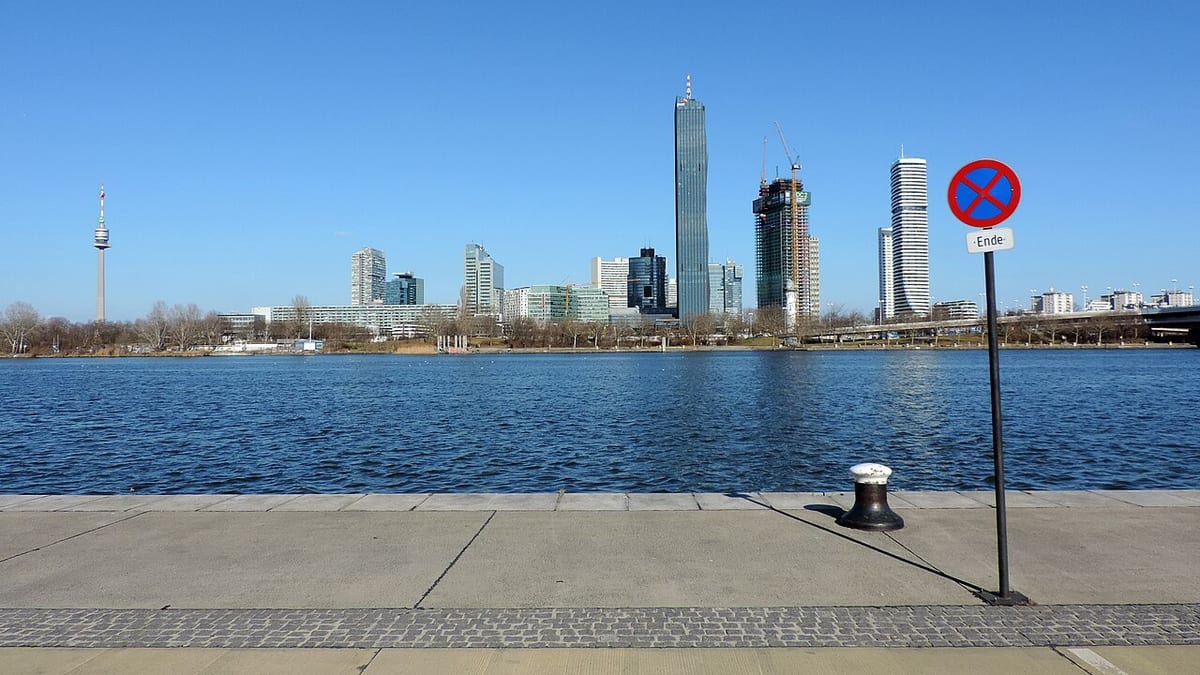
Donau City is worth visiting for a different view of Vienna: contemporary towers, the United Nations complex and open space near the Danube rather than imperial rooms and old-town lanes. Build the visit around an architecture walk, a booked UN tour or the nearby Danube Tower. Trying to fit all three into a brief stop makes this spacious district feel unnecessarily rushed. [1][2][4]
Understand the names before choosing your route
Donau City is the modern development around the Kaisermühlen area, not a name for every attraction beside the river. UNO City refers to the Vienna International Centre. Donaupark is the park farther north, while the Donauturm, or Danube Tower, stands within that park. Donauinsel is the long recreational island, and Alte Donau is a separate body of water. The tower operator's neighborhood guide helps distinguish these places on a map. [2][5]
That distinction changes a sensible itinerary. Someone attending a conference near the UN complex can enjoy a short architectural circuit without committing to the island. A traveler interested in a panoramic view should navigate to the Donauturm entrance, not simply to the tallest building visible from the station. A family seeking space to move may get more from Donaupark than from a series of office-building photographs.
Use Kaisermühlen–VIC as the starting-point search in your journey planner for the district. Then enter the actual destination for the final walking leg. A station's name is not a promise that every nearby attraction is immediately outside its exit. The surrounding area includes substantial parks and waterside spaces as well as buildings, so allow time for the ground-level journey rather than estimating it from the skyline. [1][5]
Look at the district from more than one level
The interesting feature of Donau City is not simply its height. Vienna's planning account describes a layered arrangement: pedestrians and cyclists occupy the principal public level, technical infrastructure sits below, and vehicle access and garages occupy lower levels. The development mixes offices and homes rather than functioning as a single visitor attraction. [1]
For an architecture-focused visit, notice how the buildings meet those public spaces. Look for the contrast between narrow passages and larger openings, the way tower façades change as you walk, and the relationship between the urban platform and the water. These are more revealing than collecting a photograph of each tall building from the same position.
Do not follow a car's navigation route into a lower access road when the walking route remains above it. Similarly, an inviting lobby may belong to a workplace or hotel, not a public viewing gallery. Keep the exterior walk flexible; enter only a venue with a clearly offered visitor service. That approach avoids turning a free architecture outing into a frustrating search for unofficial observation decks.
A useful personal photography exercise is to choose one building and photograph it from three distances: immediately below, across a public space and from the direction of the water. The building stays the same, but its role in the wider city becomes much easier to understand.
Make a UN visit the fixed appointment
The Vienna International Centre is a working United Nations location that welcomes visitors through organized tours. The tourism board describes general tours and a separate art-tour option, with advance booking and valid photo identification central to the visit. Availability is not the same as unrestricted access to the complex. [2]
Choose the general tour when the organizations and their work interest you. Choose the art-focused option when seeing the collection is the main reason for going. Neither should be treated as a quick substitute for an ordinary museum with continuous self-guided entry.
Book this part first, then place the architecture walk around it. Keep the identification document with you, not in luggage stored elsewhere, and use the joining instructions to identify the entrance. A visitor who arrives at the correct building but the wrong gate has not yet completed the journey.
Allow some unallocated time afterward. A guided institutional visit can prompt questions and conversation; immediately racing to a second paid appointment reduces its value. On a day without a suitable tour, the district still works as an exterior and landscape visit. There is no need to pretend that looking at the complex from outside is equivalent to going inside.
Choose Donaupark for a slower afternoon
Donaupark was developed for Vienna's 1964 international garden exhibition. The city describes a large, varied park whose former exhibition features have evolved into present-day recreational spaces. It is a separate experience from both the office district and the island. [3]
This is the better direction when your group needs a pause after a structured tour. Plan a walk with a stopping point rather than a mission to cross every path. Families can make the park the main outing and treat the towers as scenery; architecture enthusiasts can use it to see how the built district sits against a much more open landscape.
For a short winter visit, prioritize the outdoor portion while there is useful daylight. For a warm-weather outing, carry drinking water and decide where lunch fits before walking away from your chosen restaurant area. Those are itinerary choices, not claims that the park lacks services or that every venue is open throughout the year.
Decide whether the Danube Tower adds enough
The Donauturm offers dedicated viewing levels, with an outdoor terrace at 150 metres and an indoor viewing level at 155 metres. Its café and restaurant are distinct experiences, and weather or operational restrictions can affect individual facilities. A restaurant reservation and an admission decision should therefore be considered together rather than assumed to be the same purchase. [4]
Pay for the tower when understanding the city's wider geography is important to you. It is particularly useful after walking through the district: the waterways and separated neighborhoods become a connected landscape. Skip it when cloud or poor visibility would undermine the main reason you are paying, or when the group would rather spend the money on a longer meal.
For photographs, consider what you want to see rather than choosing sunset automatically. Daylight makes the geography easier to read; an evening visit emphasizes illuminated buildings. The better choice depends on your interest and the conditions, not on a universal rule that one time is always superior.
Put together a visit that fits the day
For an unhurried half-day, use one anchor: the UN tour or the tower. Add the exterior architecture walk and a park break around it. This is a planning allowance, not an official tour duration. A shorter outing can simply connect the station, a few exterior viewpoints and a waterside pause before returning.
Avoid adding both a long island walk and a separate Old Danube excursion merely because all the names contain "Danube." They are valid outings in their own right, but they change the scale of the day. Donau City is most rewarding when you use its contrasts deliberately: institutional buildings, modern residential and office architecture, then open landscape. You do not need to purchase every available experience to appreciate that change of character.