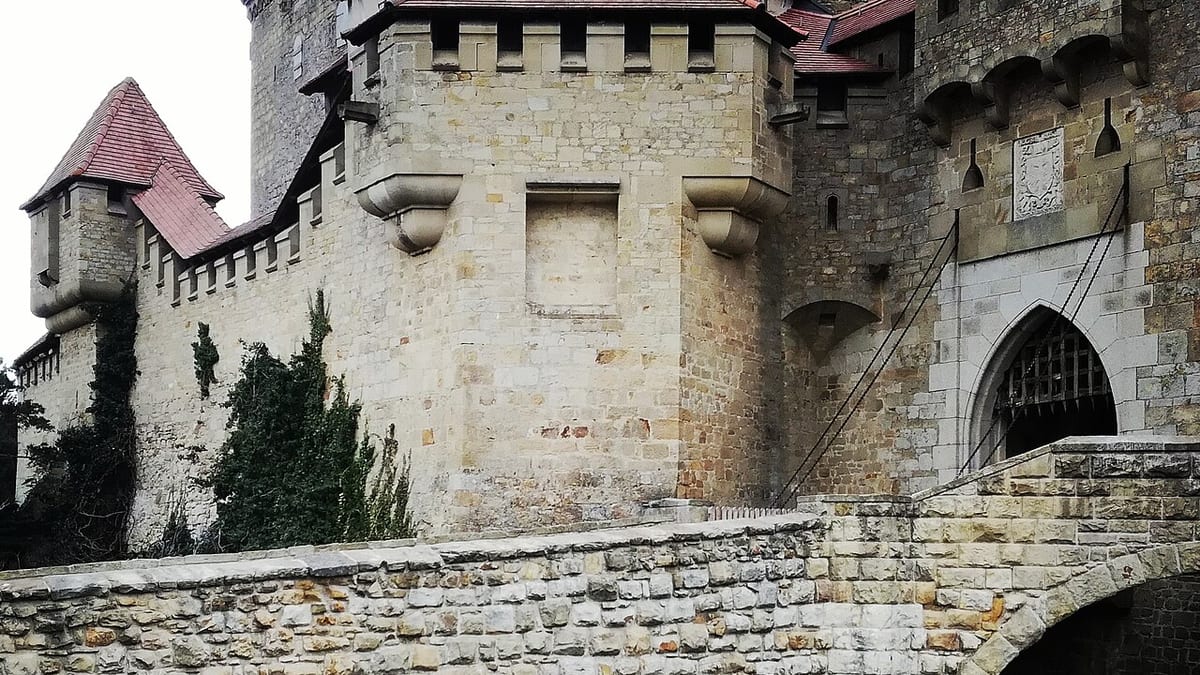
Kreuzenstein Castle is worth visiting for an atmospheric guided encounter with a collector's vision of the Middle Ages, rather than an untouched medieval fortress. It suits travelers who enjoy architecture, armor and historic interiors and can manage stairs. The crucial limitation is seasonal: ordinary visits run from April through October, so a casual winter arrival does not secure entry. [1][2]
Understand what kind of castle you are seeing
Kreuzenstein's dramatic appearance is part of its appeal, but its history needs a little explanation. Count Johann Nepomuk Wilczek began reconstructing the ruined site in the nineteenth century, incorporating historic components collected from elsewhere. The resulting ensemble formally opened in 1906. The castle's own account describes an idealized medieval castle assembled with genuine old building elements. [2]
That does not make the visit meaningless or the objects imaginary. It changes the question to ask. Instead of looking only for the exact arrangement of an original medieval household, consider how a later collector imagined, selected and displayed the past. Research supported by the Austrian Science Fund specifically treats Kreuzenstein as a historicizing creation rather than a straightforward surviving medieval building. [3]
Look for the relationship between the whole and its parts. A doorway, architectural fragment or furnishing can be old even when the room that brings the pieces together is much newer. The interesting tension is between authentic material and a deliberately composed setting.
Travelers seeking an archaeological ruin may therefore prefer a different outing. Those who enjoy richly staged interiors, collecting history or the visual drama of a castle are more likely to find Kreuzenstein rewarding. Arriving with the right expectation avoids the disappointment of discovering its reconstruction only after the tour.
The interior is a guided visit, not a free-roaming attraction
The operator admits visitors to the castle interior on guided tours lasting approximately 45–60 minutes, generally offered hourly during the season. You cannot buy a standard ticket and then wander independently through the rooms for as long as you please. The regional tourism listing confirms the guided format. [1][4]
This makes the guide part of the value. Rather than rushing to photograph every object, listen for how the rooms and collections were assembled. Ask whether a feature belongs to the earlier site, arrived from another building or was created for the reconstruction. That simple distinction can make a decorative room much more intelligible.
The guided format also affects timing. Arriving just after a departure can mean waiting for the next one, and the final tour of the day is not the moment to arrive at the car park. In October, diminishing daylight may affect the last departure. Build the outing around an actual tour rather than only the published closing time. [1]
Visitors who need English interpretation should establish what is offered on their intended departure. A website available in several languages does not prove that every tour is delivered in each language. For a group with a strong historical interest, arranging the language and focus in advance may be more valuable than choosing the first available slot.
Season, payment and the real cost of a visit
The published regular season is April 1 to October 31. The operator lists weekday and Saturday opening from 10:00 to 16:00, with Sundays and public holidays extending to 17:00. From November to March, visits are offered to groups of at least 20 by arrangement, rather than as normal individual walk-in tours. As of November 6, 2026, the ordinary season has ended. [1]
A winter photograph from outside should not be confused with an interior visit. Before making a special journey outside the season, establish exactly what access is possible and whether a private group booking is realistic. Do not travel on the assumption that a ticket office will open because another traveler has posted recent pictures of the building.
The listed standard adult admission is €15, payable in cash; the child rate covers ages three to sixteen. Parking has been charged separately since May 2026, at €2 per vehicle. Carry the appropriate payment method for admission rather than treating the availability of an app for parking as evidence that the castle accepts cards. [1]
For two adults arriving in one car, the published adult admissions and parking amount to €32 before fuel, food or any separate activity. That is a calculation from the operator's stated charges, not a bundled ticket. The largest cost for many visitors will instead be the time required to reach the site and return to Vienna.
Getting there requires a plan for the final approach
The castle's public-transport guidance points travelers toward Leobendorf-Kreuzenstein and estimates a further walk of about 40 minutes. Treat that as an operator's walking estimate, not a promise suited to every pace or mobility level. A railway station bearing the castle's name is not the castle entrance. [1]
Wear footwear suitable for an uphill approach and leave enough daylight for the return. If you intend to use a taxi for the final section, arrange the pickup as well as the outward ride. Hoping to find a vehicle waiting at a rural attraction is a weak return plan.
Driving simplifies the last stretch, but does not remove the physical demands inside. The operator explicitly warns of numerous stairs and says the castle is unsuitable for visitors with significant mobility limitations. Discuss your actual requirements before committing to travel; an exterior stop and an interior tour are different propositions. [1]
For families, consider both the walk and the guided hour. A child fascinated by castles may enjoy the interiors but still find the combined journey tiring. Bring what you need for the approach and choose a tour time that does not depend on skipping lunch or hurrying uphill.
Make it one coherent outing
The castle directs visitors to a nearby tavern and to the separate eagle attraction, but these are distinct businesses with their own operating arrangements. An available castle tour does not establish that a meal or bird-of-prey presentation is available at a convenient time. Verify a second activity before building the day around it. [1]
My recommendation is to treat the castle itself as the anchor and add only one complementary stop. Allow time to look at the exterior before entering, take the guided visit seriously, and leave a comfortable margin for the return journey. Do not try to turn an hourly guided attraction into a tightly packed sequence of appointments.
Choose Kreuzenstein when its reconstructed medieval setting is precisely what interests you. Skip it when your only aim is to collect another castle photograph, when stairs are unsuitable or when the available season does not match the trip. Its value lies in understanding the unusual collection and architecture, not in pretending it is something older and simpler than it really is.