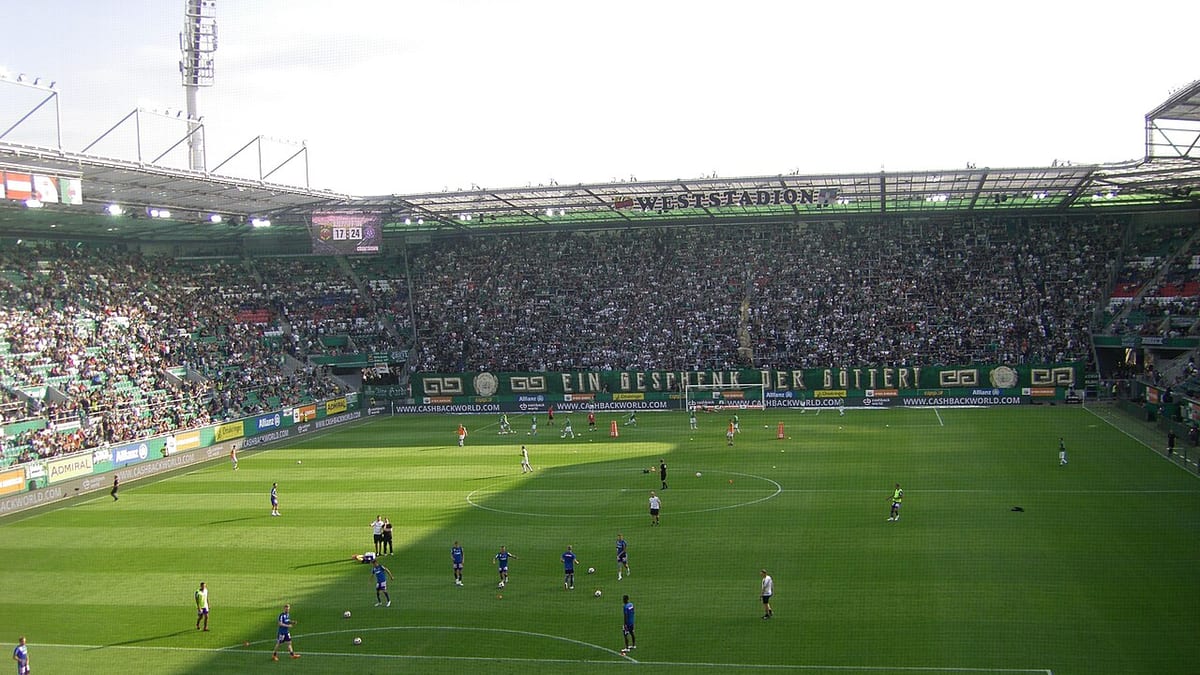
The Rapid Vienna stadium tour is worth it for football supporters and visitors interested in club culture, especially when they choose the combined stadium-and-Rapideum visit. It is less compelling as a general architectural stop. Book a guided departure: the club does not allow independent stadium exploration, although the museum can be visited separately. [1]
Choose between three different experiences
The regular combined tour covers the Allianz Stadion and the Rapideum, Rapid's club museum. The club describes a 90-minute visit split roughly equally between museum and stadium. That is an important distinction for anyone expecting the entire time to be spent beside the pitch or in operational rooms. [1]
A museum-only visit is a different product. It provides access to the collection without the behind-the-scenes stadium element, and the Rapideum publishes walk-in arrangements through the Fancorner. This is a useful alternative when no guided departure fits your trip, but it should not be sold to yourself as a substitute for seeing the stadium interior. [2]
Matchday tours form a third category. Their atmosphere and timing relate to a live fixture, while the club also sells packages combining a tour with a match ticket. A tour ticket on its own is not automatically permission to remain for the game. Read the product name and inclusions rather than assuming that "matchday" means a seat is included. [1]
For a first visit by a supporter, the combined regular tour is the clearest starting point. For someone accompanying a devoted fan but with limited interest, the shorter museum-only option may be sufficient. For visitors whose main aim is crowd atmosphere, a match is the relevant purchase; an empty-stadium tour answers different questions.
What makes the museum more than a trophy room
The Rapideum presents club history through objects, videos and models, including the earlier grounds that shaped Rapid's identity. Its display begins with the club's predecessor, the First Vienna Workers' Football Club, and follows the story into the present. The museum's compact scale encourages attention to individual objects rather than an endurance walk through endless galleries. [2]
One particularly meaningful aspect is the treatment of the Nazi period. Rapid's own museum description explicitly discusses perpetrators, followers, resistance and victims, placing sporting achievements in their historical context rather than presenting them without qualification. That makes the visit relevant to social history as well as match statistics. [2]
Use the guided part to ask about the relationship between the club and its supporters. A stadium's layout, the memory of an earlier ground and the meaning of club rituals can be more illuminating than another list of capacities and construction dates. The club frames its tours around identity and football culture, not merely access to otherwise closed doors. [1][3]
This is also a reason not to dismiss the museum half as time taken away from the stadium. Understanding what the ground represents can make the subsequent view of the stands much more interesting, particularly for visitors who arrive knowing little about Austrian football.
Prices, language and what the published calendar proves
Rapid's published regular combined-tour prices are €16 for a full-price adult, €13 for eligible reduced admission and €5 for children aged up to fourteen. The museum-only page lists €7 adult admission. Two full-price adults therefore pay €32 for the combined tour or €14 for the museum alone: an €18 difference for the party, before transport or other purchases. [1][2]
Those figures help compare products, but the dated departure list on the general tour page should not be treated as a live availability calendar. At research time it still displayed August departures. Use the official booking link reached from the club's site to establish a genuinely available date, and contact the museum team when the calendar does not resolve your request. [1][4]
The club says that regular open tours are conducted in German and English when international guests attend. That is useful for English-speaking visitors, though a bilingual tour is not necessarily an English-only presentation. Mention language needs when booking, particularly for a private group or a child who may struggle with a mixed-language explanation. [1]
Private group tours have separate pricing and arrangements. They can make sense when several people want a specific time or focus, but compare the total group charge rather than dividing a headline rate by an imagined full group. For a couple, an available public departure will usually be the more relevant comparison.
Access to rooms is not a guaranteed checklist
The club warns that the spaces accessible on a tour can vary from one departure to another. Operational needs take priority, and stadium tours are not offered on UEFA matchdays or during the specified preparation period beforehand. Do not book solely because a third-party description promises a particular changing room or press area. [1]
A good question before purchasing is whether an unavailable room would change your decision. If the answer is yes, ask about that room specifically and understand that sporting operations can still affect the route. If your interest is broader, a varied route may remain worthwhile even when one familiar photo opportunity is unavailable.
The club states that its stadium and museum tours can be arranged accessibly. Explain the practical assistance or step-free route you need when reserving, rather than assuming that every group will automatically follow the same accessible itinerary. The relevant question is whether your booked departure meets your requirements. [1]
With children, choose the product around attention span. The club distinguishes shorter stadium visits from longer combined educational visits. A child eager to see football spaces may enjoy the stadium but not a sustained historical explanation; an older child interested in club stories may appreciate both. [1]
Fit the visit around football, not a generic sightseeing circuit
The Allianz Stadion is Rapid's working home, not a centrally located museum operating independently of fixtures. Confirm the exact meeting point and allow time to find it, particularly when ticket collection is involved. Use the stadium information supplied by the club rather than a map pin that merely lands beside the building. [3]
Do not book another timed attraction immediately after the advertised end. Leave room for finding the exit, a brief shop visit and the onward journey. This is planning advice rather than a claim that tours routinely overrun; the aim is to avoid making a relaxed club visit depend on perfect timing.
The strongest reason to go is curiosity about Rapid itself. For that audience, the combined tour connects a compact historical collection with a functioning football venue and offers questions that a match ticket cannot answer. For travelers indifferent to football, the journey and guided format may outweigh the benefit. Choose it deliberately, not simply because a stadium tour appears on a list of things to do in Vienna.