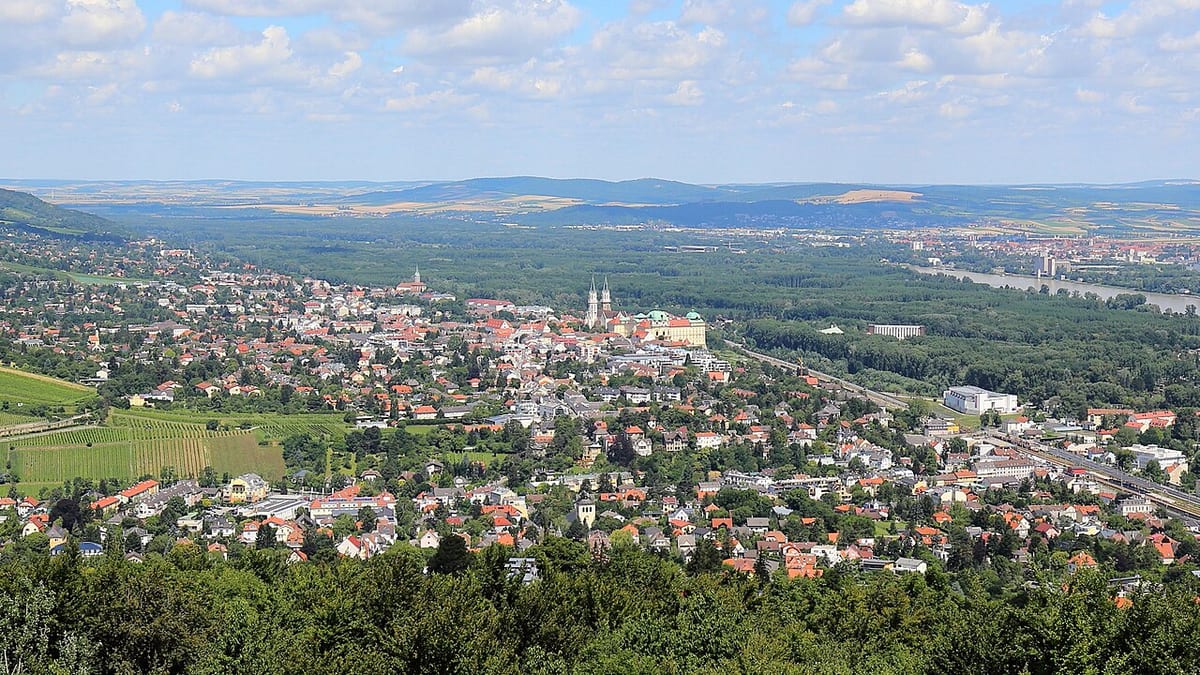
For Vienna to Klosterneuburg, compare the S40 to Klosterneuburg-Kierling with a bus from Heiligenstadt to Stiftsgarten. The bus leaves a shorter approach to the abbey; the railway suits travelers who prefer a straightforward rail journey followed by a walk. Choose the actual attraction before choosing the station, because the abbey and Museum Gugging are not one interchangeable destination. [1] [2]
Choose the stop that matches your visit
For the abbey, the official directions identify two useful approaches: S40 services to Klosterneuburg-Kierling, followed by approximately fifteen minutes on foot, or buses from Heiligenstadt to Klosterneuburg Stiftsgarten, followed by a shorter walk. The German-language directions list buses 400 and 402. Use the named stop in the journey planner rather than boarding simply because a bus displays Klosterneuburg. [1]
This is a meaningful distinction for someone with a timed guided tour. The railway station is not the abbey entrance. A journey search ending at Kierling station can look complete while leaving the final approach, reception and ticket collection outside its calculation. Enter Stiftsplatz 1 or the visitor entrance as the ultimate destination when comparing door-to-door options.
Heiligenstadt is a practical interchange for the bus approach, while the abbey's directions also identify Spittelau for the S40. Choose according to your accommodation rather than crossing Vienna to start from a station mentioned in a generic guide. The best route from a hotel near the U4 can differ from the best route from a hotel near the U6. [1]
Museum Gugging requires another decision. Its official directions use bus 400 toward Maria Gugging and the stop Maria Gugging IST Austria; a separate ISTA shuttle has weekday conditions. Do not buy an abbey visit expecting the museum to be a neighboring gallery that can be added without further travel. [2]
Allow time for the approach, not just the ride
For an abbey appointment, work backward from reception. As a planning allowance, leave thirty minutes between the scheduled arrival at Kierling station and your tour, rather than treating a fifteen-minute walk as a guaranteed fifteen-minute transfer. That extra margin is for finding the correct exit, walking at your own pace and reaching the visitor desk; it is not a measured queue estimate.
The abbey's arrival page places the visitor complex at Stiftsplatz 1. Save the entrance location rather than only a photograph of the church. Large religious complexes often have several visually plausible approaches, and heading toward the most conspicuous building is not necessarily the quickest way to the ticket desk. [1]
A bus arrival closer to the complex is attractive in wet weather or when walking is difficult. It does not establish that the entire visit is step-free. Travelers who need an accessible route should ask about the particular tour, entrances and facilities before committing to an itinerary. Transport access and access inside a historic building are separate questions.
For an unstructured visit, allow more flexibility. Arrive, orient yourself and choose what to see rather than reserving several activities back-to-back. A comfortable half-day with one principal visit is preferable to treating a nearby destination as something that must be completed in the shortest possible interval.
Match the abbey ticket to what is actually open
The current abbey notice says the Marble Hall has been inaccessible since 19 October 2026 because of restoration. Older descriptions that promise it as part of an ordinary visit should not decide your purchase. The same official page lists basic admission at €10 and a €20 day ticket including the day's offered guided tours, with separate conditions for particular spaces. [3]
The important question is therefore not simply whether the more expensive ticket contains more. Ask which tours run in a language you understand, whether their times fit your arrival, and whether those tours cover what most interests you. Buying access to several scheduled activities is poor value when your transport plan leaves time for only one.
The abbey also distinguishes museum access from general opening. The museum has weekend and public-holiday visiting windows, and worship can affect church access. A weekday visit can still be worthwhile, but it should not be sold to yourself as the same experience as a weekend visit with every listed component available. [3]
For example, a traveler mainly interested in the treasury and an exhibition can plan a shorter visit around those spaces. Someone interested in the guided interiors or wine cellar should select that activity first and build the transport around it. This sequencing avoids arriving just after the one departure that mattered.
Tickets and roadworks: avoid two false assumptions
A Vienna transport product should not be assumed to cover every journey merely because the destination is close. Buy for your complete destination and declare any pass you already hold in the fare system. This is a purchase check, not an invitation to guess where an inspector will consider the city boundary to fall. For the final connection and fare, use the transport operators linked from the attraction's official directions. [1] [2]
Roadworks are another reason to distinguish a notice from its practical consequence. Vienna's notice describes renovation of the Klosterneuburger Hochstraße from July 2026 into summer 2028, but says bus 400 and ÖBB trains remain in operation, with no major passenger restrictions expected at the time of the notice. A headline about a long construction project is not evidence that public transport has stopped. [4]
Conversely, continuing service is not a promise of an exact journey time on every day. Use the dated departure information for your trip, especially when returning for a fixed appointment in Vienna. Leave room to miss one departure rather than making the last feasible connection the foundation of the day.
When a car or a longer outing makes sense
For an abbey-only visit, public transport avoids arranging parking and driving through the northern approach to Vienna. A car becomes more useful when the day includes several places that are poorly connected to one another, or when a member of the party needs an individually arranged drop-off.
The abbey offers validated parking for up to four hours with a visit; its directions give the parking entrance and garage hours. Carry the parking ticket to reception for validation rather than assuming the barrier recognizes an admission booking. A free period also needs to cover the whole stay, including lunch or a second activity. [1]
To extend the outing, choose either another booked activity at the abbey or a separately planned journey to Gugging. Do not add both simply because they appear on the same regional map. Keep the return route visible while planning: the nicest version of this trip leaves time to enjoy the destination and still reaches Vienna without a rushed final transfer.
Sources
- Klosterneuburg Abbey: getting therewww.stift-klosterneuburg.at
- Museum Gugging: public transport and accesswww.museumgugging.at
- Klosterneuburg Abbey: admission and restoration noticeswww.stift-klosterneuburg.at
- City of Vienna: Klosterneuburger Hochstraße workswww.wien.gv.at