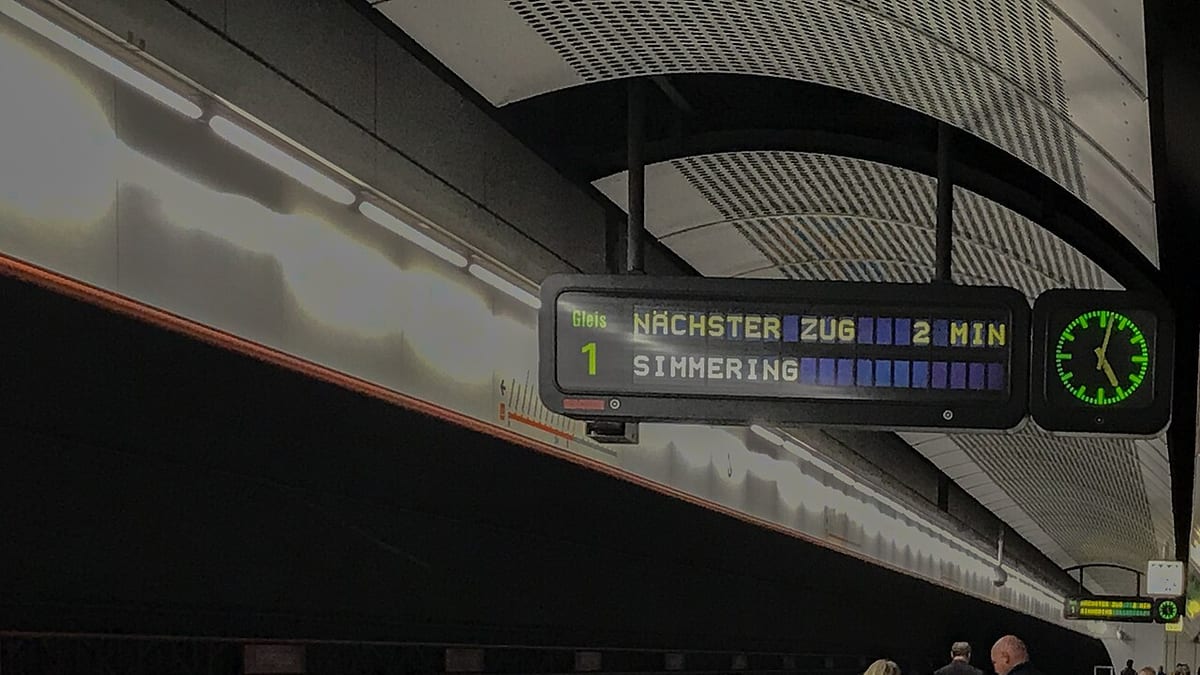
Vienna's U-Bahn normally runs from around 05:00 until around midnight, with overnight trains on Friday and Saturday nights and the nights before public holidays. Those broad hours are not the first and last departure at every station. For a late return, plan the complete journey in the operator's timetable, including any connecting bus and the final walk. [1][2]
Which nights have an all-night U-Bahn?
The overnight pattern is the useful distinction for a visitor. On Friday night into Saturday, Saturday night into Sunday, and the night before a public holiday, the underground operates through the night at approximately fifteen-minute intervals. On an ordinary Sunday night into Monday, do not assume the weekend arrangement continues. [1]
The calendar can make a description such as "Saturday night" confusing. A departure at 01:15 on Sunday belongs to the late part of a Saturday evening out, but a journey planner requires Sunday's date. Enter the date shown on the clock when you will actually travel. This small step avoids comparing the wrong operating pattern.
A public holiday introduces another condition. The relevant overnight service is the night before the holiday, not automatically the night after it. Rather than deciding from the name of a festival or a school holiday, use the exact travel date in the official timetable. A cultural event is not necessarily a statutory public holiday.
Even on an all-night underground date, a connecting tram or local bus may not run to the same pattern. A hotel described as "near public transport" can still require a different final leg after midnight. Check the entire route to the address, not only whether the U-Bahn line itself remains open.
Why "until midnight" is not a last-train time
A line's operating span describes a network pattern. It does not mean a train leaves every platform at precisely 00:00. Direction, starting station and interchange all affect the final useful departure. The city and tourism authority direct passengers to Wiener Linien's timetable information for individual services. [1][2]
For example, imagine dinner ends at 23:40 and your hotel requires two lines. The important question is not whether the first station is still open. It is whether the second train can still be reached after the first journey and the interchange. A journey planner can reveal that an apparently convenient first train no longer makes a useful connection.
For an ordinary weekday night, I recommend choosing a return journey before going out and noting one earlier option. This is particularly worthwhile when you have a timed performance, a large group or luggage. The earlier option creates a practical margin without requiring you to abandon the evening unnecessarily.
Do not interpret a station entrance remaining accessible as proof that another train is coming. Look at departure information and any service notices. If a planned connection disappears, switch to the identified alternative rather than repeatedly moving between entrances in the hope of finding a different result.
Night buses are part of the plan, not just an emergency
Vienna's NightLine buses operate every night, approximately between 00:30 and 05:00, generally at half-hourly intervals. Ordinary Wiener Linien tickets are valid on the night network. This provides a public-transport alternative on nights when the U-Bahn does not run continuously. [1]
A night-bus route may not duplicate the daytime journey you learned on arrival. Save the stop name, direction and destination before leaving a venue. A screenshot of the useful departure and a pin for the boarding stop are more helpful than simply remembering that there is "a bus somewhere near the station."
Allow for the wait as well as the time moving. A half-hourly service can be perfectly suitable for a relaxed evening, but missing one departure matters more when you have an early flight or someone in the group cannot comfortably stand outside. In those circumstances, compare the whole door-to-door journey with a taxi rather than comparing only vehicle fares.
Night services also make hotel location more meaningful. A direct night bus near your accommodation can be more convenient than an additional underground interchange and a long walk. When choosing between otherwise similar hotels, test one realistic late-evening journey rather than relying only on distance from the historic centre.
Tickets: a service that runs is not a ticket that remains valid
An overnight train still requires a valid ticket. A time-based pass can expire during an evening even when the transport network is operating. Check the validity shown on the ticket instead of assuming that buying it "for Saturday" covers every journey into Sunday morning. [3]
The 2026 ticket range also differs from older travel guides. Wiener Linien's ordinary 48-hour and 72-hour tickets were withdrawn from 1 January 2026; current short-stay options need to be compared using the operator's present products. This does not mean that every separately branded visitor card with a multi-day package has disappeared. [3]
Select a ticket according to actual journeys. Someone spending most of a day walking the centre may make a different choice from a visitor travelling between several outer districts. Do not buy a longer product simply because an old itinerary recommends it, and do not assume a transport ticket includes an attraction admission.
For paper tickets, follow the validation instructions attached to the product. For digital tickets, establish when validity begins and which passenger or device the purchase is associated with. Resolve those details while you still have time and connectivity, not after a train has arrived.
The airport is a separate late-night calculation
Vienna Airport is not a U-Bahn stop. Airport rail and bus services have their own routes, operating hours and ticket conditions. A city-centre underground service running all night does not establish that the onward airport connection also operates at that moment. [4]
Current rail works make older airport instructions especially unreliable. The City Airport Train operator is running a replacement bus arrangement during the main-line closure period. Do not build a November 2026 or 2027 airport plan around an unqualified claim that the CAT train always takes sixteen minutes. [4][5]
For an early departure, start with the time you need to be inside the airport terminal. Work backwards through the airport service, the journey to its departure point and a disruption allowance. If the first feasible public-transport connection is too late, an airport hotel or prearranged road transfer may be the sensible choice.
Finally, retain a fallback that works without your phone's battery. Write down the hotel address, the relevant night-bus stop and a contact number for the accommodation. The aim is not to make late travel sound difficult; it is to turn a broad statement about opening hours into a journey that actually reaches your destination.